Is it really a fact...
Or is it just a fact to us?
Here we are again, searching for the truth about sleep. Sometimes we are looking out of curiosity, and sometimes it’s to justify last night’s lack of sleep. If you find yourself curious, check out my blog, Yes, you should be sleeping more. And if you find yourself on the other side of that coin, trying to justify your minimal sleep, check out Ain’t No Rest for the Wicked. Whichever way you find yourself, we all have something in common, we can’t seem to find a straight answer.
Because of the overwhelming access to information, we find ourselves continuously scrolling page by page trying to find what is true and false when it comes to sleep. We all sleep, yet no one consistently knows why or how much. When you deep dive on the internet you can find anything you want to hear, prove any theory you have made up, and it becomes hard to decipher what is fact or myth.

Together, let’s deep dive and investigate what is fact and myth. Let’s uncover eight myths that we can cross off our list of sleep beliefs and excuses.
Myth: Alcohol can help you fall asleep easier.
Fact: Although you get little drowsy after that second glass of wine, this is not the secret weapon to a quick bedtime slumber. Despite your alcohol efforts, that buzz actually can disrupt your sleep. One study has found that high doses of alcohol can lead to a poor quality of sleep. Along with that, having alcohol at night can lead to more sleep disturbances and more day-time drowsiness. Next time you pour another glass, rememeber that you’re doing it for the taste and not for your sleep health.
Myth: Naps only slow you down during the day.
Fact: We all crave that mid-day power nap but force ourselves to stay awake because of the dreaded fear of grogginess. Well worry no more because this nap study showed that a 15 min power nap can show immediate increases in productivity for up to three hours. For those long nap lovers, they have something for you too! Although longer naps can lead to an immediate grogginess, after taking some time to wake up, it will increase your productivity for an even longer period of time. So, nap on happy people!
Myth: If you can’t fall asleep tonight, you can just catch up later.
Fact: Every night that you can count the amount of hours you slept on one hand, you’re actually accumulating hours and hours of sleep debt. This means that your body it keep a tally of every night you don’t get enough sleep and as hey add up negative health consequences can occur. It takes a consistent sleep schedule to repay your sleep debt and that won’t happen in one night or even over a weekend.
Myth: Watching TV can help me fall asleep at night.
Fact: Most of us have a TV in our bedroom, but unfortunately that TV is damaging your sleep every night. That illuminating light filling up the room is actually a very harsh blue light that leads to severe sleep disturbances and disruptions throughout the night. That light is telling your brain to stay up while your body is telling it to go to sleep, and that sleep confusion leads to an unsatisfying night’s rest. If you want to find out more, check out my blog, Don’t Go Towards the Blue Light.

Myth: All sleep quality is the same, you’re either asleep or not.
Fact: Despite what we think, when we fall asleep, it is not light an on/off switch. We actually go through four stages of sleep and each one is distinct and just as important as the rest. Therefore, the sleep quality you generate actually does make a difference. The ultimate goal is to reach a level of deep sleep so you can receive the peak health benefits. An added “cool factor” of getting deep sleep is it will help you retain memories and process them for long term storage. The next time you feel spacey, it might be because of your sleep quality not just your sleep quantity.
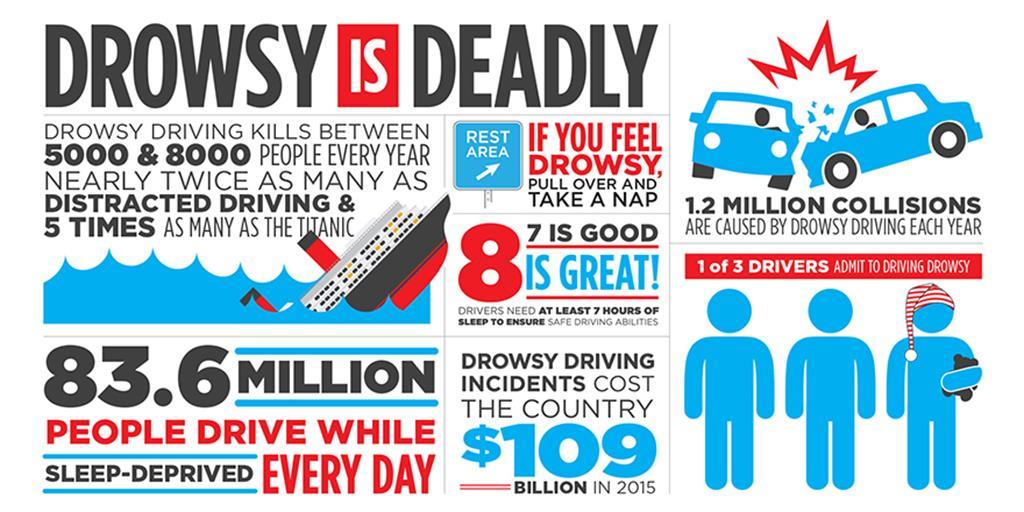
Myth: Being tired doesn’t affect my driving
Fact: Driving anywhere when you’re tired is known as drowsy driving. This can dramatically affect your ability to drive, and is considered just as bad as drunk driving. According to a 2016 study, being awake for 24 hours is comparable to driving with a blood alcohol level of 0.10 which is above the legal limit. The lack of sleep makes a huge difference in the ability to concentrate and respond to something. Being tired is not a lazy person’s excuse for not driving, it is a smart person’s choice.
Myth: Pulling an all-nighter is the only way to pass a test
Fact: Barely being able to keep your eyes open doesn’t seem like the best way to guarantee an A. Sleep deprivation is not how to pass a test, and ends up actually being counterproductive to success. An attention and mood study showed that one night without sleep can lead to an increase in depression and a decrease in ability to focus, and keep consistent attention. Your best bet is to cut the studying off earlier to ensure that you can get those important eight hours of sleep a night.
Myth: Melatonin is a natural sleeping pill
Fact: Yes, it is true that Melatonin can help you get to sleep. However, it is not in the way you think. Melatonin doesn’t act as a sleep inducing agent like one might think. Instead, it is a circadian rhythm adjusting agent that can reset your internal clock so your body can go to sleep when it is suppose to. Melatonin is a naturally occurring hormone in the body that helps our bodies keep a 24 hour sleep awake cycle. When you can’t go to sleep at night you can take a melatonin supplement that helps your body adjust and allow it to produce the natural sleep cycle at the right time.
It turns out a lot of the information we have received about sleep is actually a myth. We have picked up all this information through hours of scrolling, but it wasn’t all true. Now you must reevaluate the beliefs you’ve taken to be true and the hard truth of the lies you have been telling yourself. We are all guilty of believing the myths, but it’s important to eventually land on the truth.
To find out more about sleep health, follow the National Sleep Foundation:
Twitter: @sleepfoundation

To stay connected and learn more about sleep, follow me:
Twitter: @midnighthealth
Facebook: Midnight Health and Wellbeing
 Midnight Health and Wellbeing
One thought on “Myth Busters: Sleep Edition”